Schedule of values for Texas subcontractors: reconcile each progress billing
Reconcile a Texas subcontractor schedule of values with worked examples for stored materials, retainage, approved changes and current payment requests.
Direct answer
A schedule of values (SOV) allocates the approved contract amount to work items and supports progress billing. Reconcile completed work and eligible stored materials, then separate retainage, previous requests and cash received. A current payment request does not prove earlier requests were paid or establish a lien deadline.
A schedule of values gives the billing amount a structure
A general contractor returns your payment application with one question: “How does this amount tie to the subcontract?” A schedule of values gives the reviewer a consistent list of work items and their agreed dollar values. That list makes the billing calculation easier to follow than one unsupported percentage for the entire job.
AIA describes a schedule of values as an allocation of the contract sum across portions of the work. Its subcontractor continuation-sheet documentation connects line items with completed work, stored materials, retainage and payment information. Your project may use an AIA document, a contractor spreadsheet or a billing portal; follow the actual contract’s required format.
The tables in this guide are original operational examples for checking numbers before submission. Follow the project’s required payment application and its instructions; these examples are not a licensed AIA form or a replacement certification.
For materials purchased before installation, use the stored-materials billing packet to support storage eligibility and avoid billing the same material twice.
Once the scope lines reconcile, use the free progress payment reconciliation calculator to compare cumulative earned amounts, retainage, previous net requests and cash receipts. Export its arithmetic summary for your review packet; it does not replace the agreed payment application.
Approve the baseline before percentages become a dispute
Start with the signed subcontract amount and prepare a work breakdown that the project team can verify. A hypothetical electrical package might separate mobilization, rough-in, equipment installation and testing. Use work descriptions that match the scope and avoid moving money between lines simply to increase this month’s request.
Record the reviewer, approval date and version. If the general contractor requests a revision, preserve the original and show what changed. A clean audit trail prevents two people from using different totals while believing they are working from the approved schedule.
Confirm whether approved changes are added as new rows or incorporated into existing rows. Keep pending changes outside the approved contract total unless the contract’s billing rules permit another treatment. The unpaid change-order guide describes how to preserve directions and unresolved pricing.
For a simple baseline check, start with a $100,000 approved subcontract and a separately approved $5,000 addition. The revised approved total is $105,000. In this example, another $3,000 pending change remains in the pending register instead of silently increasing that total. Record the change reference, authorization and effective billing cycle; the actual contract governs directives, disputed work and other adjustments.
Check the AIA invoice against the schedule-of-values baseline
People sometimes call a payment application an AIA invoice. Confirm which document and edition the customer actually requires. A schedule of values provides the line-item breakdown behind the request; it does not establish that the architect or customer has certified the amount or sent payment.
At review, compare the approved contract baseline, authorized changes, completed and stored work, retainage and prior applications. AIA’s official guidance distinguishes fixed retainage percentages from variable line-item retainage. Use the project-specific instructions rather than assuming every line must use the same method.
An ordinary current-period invoice can accompany a supporting packet where accepted, but it should not silently replace the specified application. The construction invoice template guide explains that scope, while the progress-billing guide explains the cumulative bridge.
If you are deciding what to submit, the pay application vs invoice comparison separates an ordinary invoice from a cumulative application and its supporting SOV. Confirm the cutoff, submission channel, form edition and reviewer before preparing the packet.
| Review input | Compare against | What it does not prove |
|---|---|---|
| Contract and changes | Approved SOV baseline | That unsupported extras are accepted |
| Earned and stored amounts | Work and storage evidence | That cash was received |
| Retainage method | Agreement and application instructions | That release is authorized |
| Prior applications | Earlier approved/requested records | That earlier amounts are fully paid |
Schedule-of-values columns: what each number means
Use the following field map for the original examples below. Keep input facts separate from calculated balances. A project-specific application can define previous certificates or payments differently; use its instructions rather than relabeling this internal reconciliation as the required form.
For earned percentage, divide total earned value by total scheduled value. In the first example, $36,000 divided by $100,000 is 36%. Averaging 100%, 50%, 0% and 40% would give 47.5%, which ignores the different dollar values of the work items.
| Field | Meaning in this example | Review check |
|---|---|---|
| Scheduled value | Approved value allocated to one scope line | All lines reconcile to the approved baseline |
| Previously installed | Installed work before this period | Exclude material still in storage |
| Installed this period | Work incorporated during this period | Include previously stored material installed now once |
| Presently stored | Eligible uninstalled material remaining at cutoff | Reassess inventory and its supporting evidence |
| Earned to date | Previous installed + current installed + presently stored | Do not count one material in two buckets |
| Earned percentage | Earned to date ÷ scheduled value | Use value-weighted totals, not average percentages |
| Retainage held | Amount held under the agreed calculation method | Confirm the applicable rate and base |
| Cumulative net request | Earned to date less retainage in this simplified model | Account separately for other project adjustments |
| Current incremental request | Cumulative net request less previous net requests | Keep older unpaid requests out of new earned work |
| Cash received | Actual receipts allocated to these requests | Trace each receipt to its reference |
| Outstanding net | Cumulative net request less allocated receipts | Review credits, disputes and unapplied cash separately |
| Unfinished value | Scheduled value less earned to date | Excludes retainage on already earned work |
| Unfinished value including retainage | Scheduled value less net earned value | Includes both unfinished work and the held amount |
Worked example: from $36,000 earned to an $18,000 current request
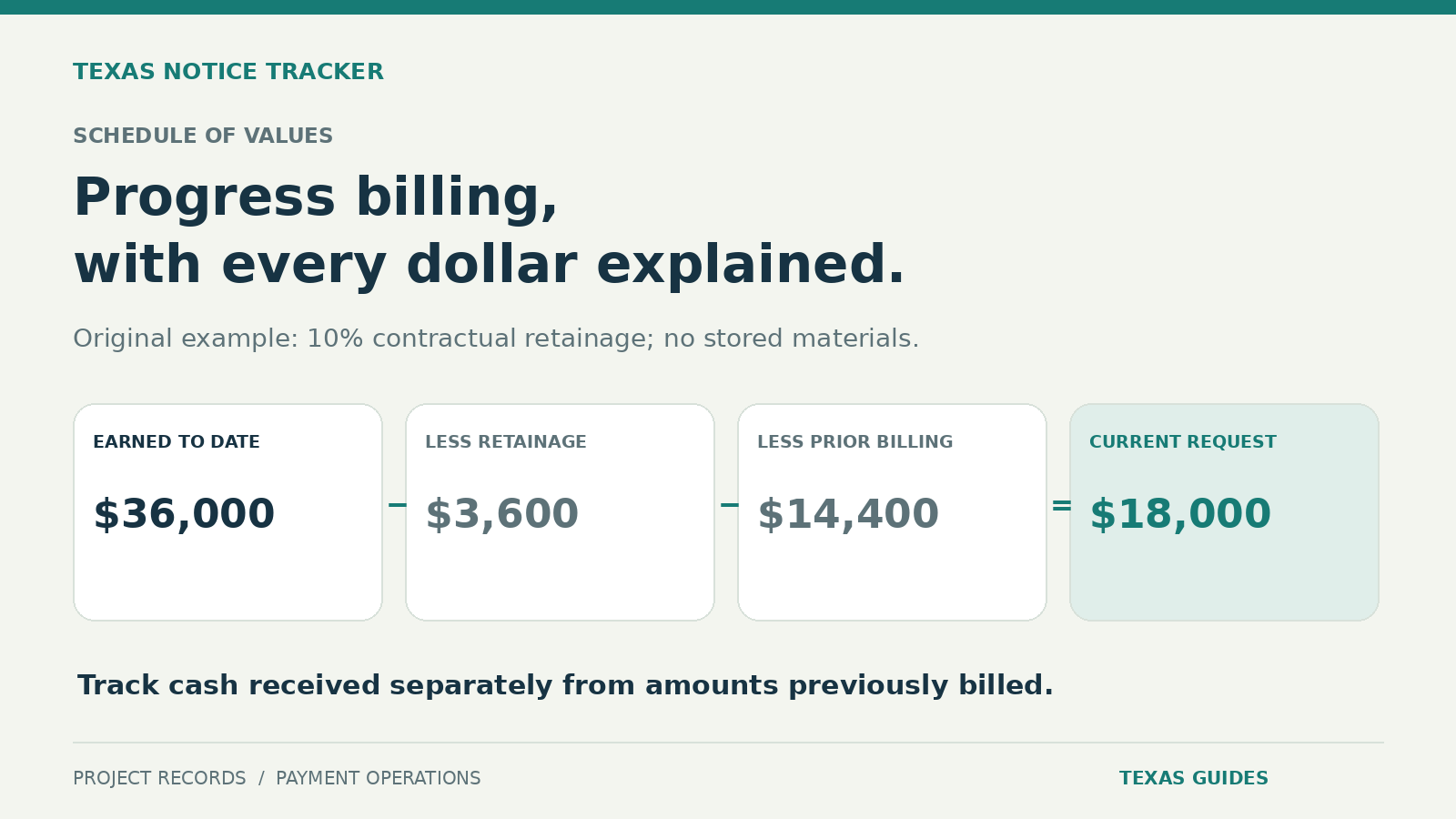
Hypothetical example: the approved contract is $100,000. Four work items total that amount. At the current cutoff, completed work totals $36,000. Assume no stored materials, no approved changes and a uniform 10% contractual retainage on the earned amount. Retainage is $3,600 and cumulative earned value less retainage is $32,400.
Assume the prior cumulative amount billed net of retainage was $14,400. The current incremental request is $32,400 minus $14,400, or $18,000. This is a billing calculation. It does not establish the amount of cash received, statutory retainage requirements or eligibility to claim a lien.
| Work item | Scheduled value | Completion in example | Earned to date |
|---|---|---|---|
| Mobilization | $10,000 | 100% | $10,000 |
| Rough-in | $40,000 | 50% | $20,000 |
| Equipment installation | $35,000 | 0% | $0 |
| Testing and closeout | $15,000 | 40% | $6,000 |
| Total | $100,000 | 36% by value | $36,000 |
Two billing cycles: move stored material into installed work once
This separate hypothetical example uses one $20,000 equipment line, a fictional uniform 10% contractual retainage and no taxes, credits or changes. The previous cycle included $8,000 of eligible stored equipment and no installed work. The current cycle installs all of that equipment and earns another $2,000 of installation value.
The current installed amount is therefore $10,000: $8,000 of equipment plus $2,000 of new installation. Presently stored falls to zero. Cumulative earned value rises from $8,000 to $10,000, not to $18,000. The current incremental net request is $9,000 less the previous $7,200 request, or $1,800.
AIA’s G703–1992 instructions explain the movement between completed work and remaining stored materials. That is guidance for a named contractor-level form and edition; G703S is a separate subcontractor document. Check the actual project instructions. Installation changes the stored-material classification; receiving payment alone does not.
A common error is to carry the earlier $8,000 stored amount into previously installed work and also include it in the $10,000 installed this period. That produces $18,000 earned instead of $10,000: an $8,000 gross overstatement, or $7,200 net under this example’s assumptions. Use the stored-material billing checklist to trace the supporting records.
| Original equipment-line example | Previous cycle | Current cycle |
|---|---|---|
| Scheduled line value | $20,000 | $20,000 |
| Installed before this period | $0 | $0 |
| Installed this period | $0 | $10,000 |
| Presently stored at cutoff | $8,000 | $0 |
| Earned to date | $8,000 | $10,000 |
| Earned percentage | 40% | 50% |
| 10% retainage held — example only | $800 | $1,000 |
| Cumulative net request | $7,200 | $9,000 |
| Previous cumulative net requests | $0 | $7,200 |
| Current incremental request | $7,200 | $1,800 |
The same equipment line: unpaid cash and unfinished value
Suppose the customer paid only $5,000 against the earlier $7,200 net request. That leaves $2,200 from the previous cycle. Add the new $1,800 request and total outstanding net is $4,000. The cross-check is $9,000 cumulative net requested minus $5,000 actual receipts. These figures reconcile the example; they do not decide when an amount is legally due.
Do not replace the current $1,800 request with $4,000 without explaining the prior balance. Keep the current application, older unpaid request and payment allocation visible as separate records.
Two finish balances also need clear labels. The remaining unearned scope value is $20,000 minus $10,000 earned, or $10,000. Including the $1,000 already-earned retainage gives $11,000. That second number is not all unfinished work: it combines unfinished value with money held on completed work.
| Current-cutoff balance | Calculation | Result |
|---|---|---|
| Previous unpaid net request | $7,200 − $5,000 | $2,200 |
| Current incremental request | $9,000 − $7,200 | $1,800 |
| Total outstanding net | $2,200 + $1,800 | $4,000 |
| Unfinished value | $20,000 − $10,000 | $10,000 |
| Unfinished value including retainage | $20,000 − $9,000 | $11,000 |
Previous billing and previous payment are different numbers
Now assume only $10,000 of the earlier $14,400 net request was actually paid. The prior unpaid balance is $4,400. Adding the new $18,000 request produces $22,400 outstanding net billing in this simplified example. Showing only the current request would hide money that remains owed from the prior cycle.
Some application formats use labels that combine certificates, prior requests or payment history differently. Read the field instructions carefully. Your internal ledger should still keep cumulative earned value, amounts requested, amounts approved and cash actually received separately. Never substitute one for another because a portal uses a short label.
If you maintain a cash-application record, link each receipt to its invoice or application reference. Keep an unexplained receipt in an unapplied status until the allocation is confirmed. The construction partial-payment guide supports that separate reconciliation.
| Example calculation | Amount |
|---|---|
| Cumulative earned value | $36,000 |
| Less 10% retainage | $3,600 |
| Cumulative net billed value | $32,400 |
| Less prior net billing | $14,400 |
| Current incremental request | $18,000 |
| Prior cash received | $10,000 |
| Prior unpaid net billing | $4,400 |
| Total outstanding net billing | $22,400 |
Support the percentage and prevent double counting
Use a cutoff date and identify who verified each completion amount. Photos, daily reports, measurement sheets, delivery records and inspection status can support different lines. A photograph of material on the site does not establish that an installation line is complete. Record the observation and its limitations.
Where the contract permits billing stored materials, confirm required evidence, location, ownership or insurance documentation and approval conditions. Keep stored and installed quantities distinguishable so the same material is not billed twice when it moves into the work. Do not assume every contractor’s stored-material policy is identical.
Attach the source records through stable references. A reviewer should be able to move from “rough-in 50%” to the dated record used to support that figure. The daily-work-report guide and delivery-ticket guide explain two useful supporting records.
Keep retainage and changes visible through closeout
A contract may apply different retainage treatment to particular components or change the rate after a milestone. Record the applicable term instead of hard-coding one percentage into every project. The 10% in this example is an assumption, not a universal Texas requirement.
For the financial distinction between held, released and received amounts, use the practical construction retainage guide. Keep that calculation separate from the notice and filing review linked below.
Track retained amounts as their own balance. When release conditions are met, connect the release request to the retained balance and supporting closeout documents. An application marked “final” should not erase the history of what was retained or which amounts remain disputed.
Use the Texas retainage notice guide for the separate notice and filing questions. A schedule of values is a billing record; it does not determine a statutory deadline.
Progress-billing review checklist
Before submission, compare the application with the approved baseline, prior cycle and cash ledger. Have a second person review the arithmetic when the project includes changing retainage rates, multiple adjustments or substantial stored materials.
- Scheduled values total the approved contract amount.
- Approved changes reconcile to the revised contract value.
- Each completion figure has a cutoff date and support.
- Stored materials are not also billed as installed work.
- Reconcile prior installed work, this-period installation and remaining stored inventory across both cycles.
- Retainage follows the applicable contract terms.
- Current request reconciles with prior billing.
- Actual receipts and prior unpaid balances stay separate.
- The submitted version and receipt confirmation are preserved.
- Label unfinished value separately from unfinished value including retainage; flag negative balances or earned amounts above the approved line value for review.
Schedule-of-values questions
Is a schedule of values the same as an invoice? No. It supplies the work-item breakdown used to support a payment request. The project’s contract determines the required submission package.
Is an AIA form mandatory for every Texas subcontract? Do not assume that. Check your contract and the billing instructions. This article provides an original example, not an AIA form.
Can I use percent complete as proof of when work occurred? Preserve actual activity dates separately. A cumulative billing percentage does not show every work month; use the work-month tracking guide.
What if the current request is approved but unpaid? Record approval and cash receipt as separate events, keep the balance open, and continue collection and deadline review.
What does SOV mean in construction? It means schedule of values: the approved allocation of contract value across work items used to support progress billing.
Does installing previously billed stored material earn its full value again? No. Move that material from remaining storage into installed work once. In the equipment example, only $2,000 is newly earned, producing a $1,800 incremental request after the fictional 10% hold.
Can I use a generic schedule-of-values Excel template? Confirm the project’s required format first. Map its fields to the approved baseline, period cutoff and retainage method, then test carryforward and cash reconciliation. This article supplies original worked tables; the separate invoice workbook is for ordinary current-period invoices.
Related reading
- Build a subcontractor invoice packet
- Separate work months from billing dates
- Understand contractual retainage
- Reconcile percentage-complete progress billing
- Calculate current billing separately from older unpaid requests
- Download the construction invoice template
- Compare a pay application with an invoice
Turn project facts into a review queue.
Keep unpaid work months, parties, invoices, documents and estimated review dates in one private workspace.
Create your free accountOfficial sources
- AIA Contract Documents: schedule of values overview
- AIA G703S subcontractor continuation sheet: document information
- AIA G703–1992 instructions: completed work and stored-material carryforward
- Texas Property Code Chapter 53: separate lien and retainage framework
Source note: Reviewed October 17, 2026. Verify the current statute and obtain qualified advice for a specific project or claim.