How to find a property's legal description in Texas for a construction claim
Find and compare Texas deeds, plats and appraisal records before preparing a construction claim, with a parcel example and property-research checklist.
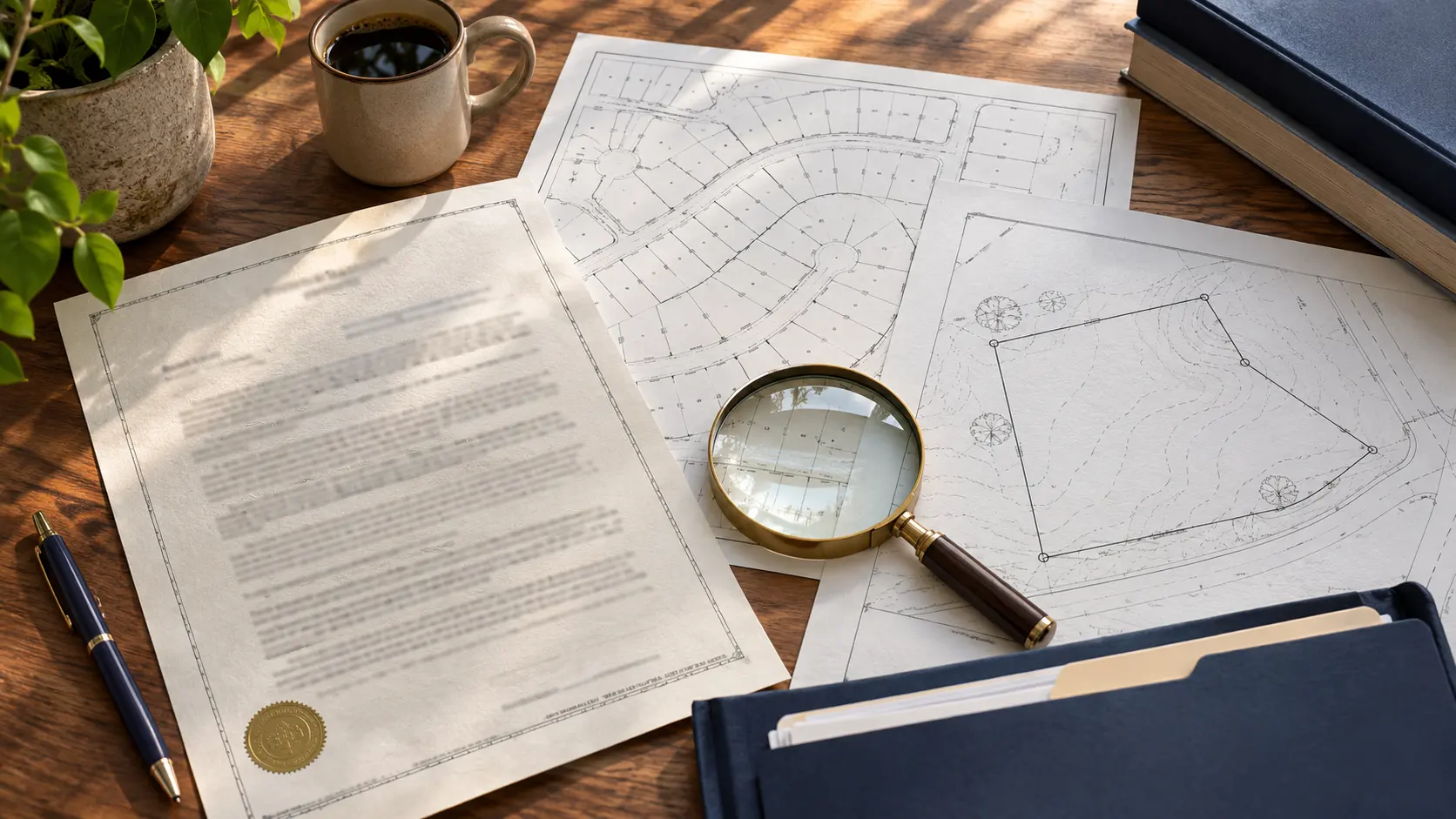
Direct answer
Start with the county where the property is located, use local appraisal records to identify the parcel, then obtain and read the relevant recorded deed and any referenced exhibits or plat. A street address, tax account number and legal description are different identifiers. For a construction claim, have the description and the property interest checked for legal sufficiency; do not copy a shortened search result into an affidavit without review.
Street address, parcel number and legal description are different
A street address helps a crew find the job. A tax account or appraisal number identifies a record in a local system. A legal description identifies land through recorded information such as a lot and block, subdivision reference or metes-and-bounds description. Similar addresses can belong to different parcels, and one commercial project may span several tax accounts.
The Texas Comptroller's appraisal-record materials distinguish the situs address from the legal-description field. That is a useful reminder to keep both in the project file. A contractor's job nickname, suite number or Google Maps pin should not be silently substituted for the property description.
Section 53.054 requires a description legally sufficient to identify the property sought to be charged with the lien. The research steps below help collect source records. They do not establish that a description is sufficient for a particular claim or that all land in a development can be included.
Step 1: identify the county and candidate parcel
Confirm the physical county rather than relying on the customer's mailing address. City boundaries, ZIP codes and postal names do not always resolve the county question. Use the Texas Comptroller's local directory to locate the relevant appraisal district, then search the job address or verified owner name.
Record the appraisal account number, situs address, owner as displayed and the date checked. Save the page or a PDF with its source URL. Treat the owner entry as a research lead, not a title opinion. Ownership may have changed, a trade name may be used at the site, or a tenant may be the customer who ordered the improvement.
If the address produces multiple accounts, list each candidate and why it may relate to the work. Do not select the first result only because its description looks familiar. For large sites, ask the project team for the relevant parcel, survey or deed reference.
Step 2: retrieve the deed and all referenced pages
Go to the county clerk's real-property records or recording office. Search using the instrument number if you have it; otherwise use the owner/grantee name and a reasonable date range. Portals differ. On the Harris County clerk's system, name and date searches are among the documented tools, and its help page explains name-entry conventions.
Open the full instrument image, not just the index. Find the property description and read every referenced exhibit. If the deed says see Exhibit A, a cover page without Exhibit A is incomplete. Record the instrument number, recording date, grantor, grantee and page count so another person can retrieve the same document.
An online portal may lag behind recording or omit material available from the clerk. Harris County warns that its online database is not the official repository and may not reflect complete, unaltered records. Contact the clerk when the image is missing or a certified copy is needed. Verify current copy procedures directly rather than assuming a download is certified.
Step 3: understand what the description points to
You do not need to redraw a boundary to organize the file. You do need to notice a missing page, an exception or a mismatch. Have a title professional, surveyor or qualified attorney resolve boundary, ownership or legal-description questions. Do not shorten metes-and-bounds calls to make them fit a software text box.
| Description type | What to retrieve | What to compare |
|---|---|---|
| Lot and block | Deed plus referenced subdivision plat | Lot, block, subdivision phase and recording reference |
| Metes and bounds | Complete field-note exhibit and available survey | Beginning point, calls, exceptions and tract identity |
| Condominium or unit interest | Deed and referenced condominium records | Unit, common-interest references and project work location |
| Multiple tracts or exceptions | All exhibits and excluding/reserving language | Whether the improved area is actually included |
Worked example: one job address, two candidate parcels
Fictional example: a subcontractor works at 100 Example Business Park Drive. The address search shows two tax accounts. One corresponds to the main building; the other appears to cover an adjacent lot. The subcontract identifies only Suite 200, and a delivery slip refers to Phase 2.
The office creates two candidate rows instead of choosing both parcels for the claim. It retrieves the current deed references, checks the plats and asks the hiring contractor to identify the building and phase covered by the scope. A reviewer then compares the work location with the recorded property information.
The outcome might be a verified single parcel, a multi-tract project or a tenant-interest issue requiring further advice. The purpose of the research is to expose that question before the affidavit is prepared. It is not to enlarge the claim to every parcel sharing an owner or street address.
Step 4: reconcile the property with the contract chain
Place the deed information beside the agreement, purchase order, project plans and notice records. Distinguish the property owner, tenant, developer, original contractor and company that hired your firm. One entity may have several roles, but that should be verified rather than assumed from a shared contact person.
Use the project-information request guide to organize missing owner, contractor and bond information. The contractor vs subcontractor guide helps explain the different positions in the contract chain.
Save a clean source copy and a separate working note. Mark unresolved items clearly, including recent transfers, conflicting names, missing exhibits and improvements crossing parcel boundaries. A later reviewer should be able to distinguish recorded facts from your office's interpretation.
Property-research checklist before claim drafting
- Physical county and complete job address verified.
- Candidate appraisal account numbers and research dates recorded.
- Relevant deed instrument numbers and full images obtained.
- Every referenced exhibit, plat and available survey reviewed for missing pages.
- Owner, tenant and contracting entities kept in separate fields.
- Work location compared with the actual tract or unit described.
- Exceptions, multiple parcels and discrepancies escalated for professional review.
- Description checked with the other lien affidavit requirements.
Texas property-description FAQs
Can I use the tax website's abbreviated description? Use it to locate source records. Whether it is legally sufficient for a particular instrument requires a separate review.
Is a mailing address the property address? Not necessarily. An owner's mailing address can be in another city or state; the situs address identifies the property location.
Does this search prove who owns the property today? A useful record search is not a title examination. Recent instruments, interests and exceptions may need professional investigation.
What if I cannot find the deed before a deadline? Escalate promptly and keep the deadline review active. Do not invent a description or assume that searching records extends any legal date.
Related reading
- Texas lien affidavit filing requirements
- Texas construction project information request
- steps to file a mechanics lien in texas
Turn project facts into a review queue.
Keep unpaid work months, parties, invoices, documents and estimated review dates in one private workspace.
Create your free accountOfficial sources
- Texas Comptroller: local appraisal district and tax-office directory
- Texas Comptroller: appraisal-roll field definitions, including situs and legal description
- Harris County Clerk: real-property document search and record limitations
- Harris County Clerk: official search help
- Texas Property Code Section 53.054: affidavit contents
Source note: Reviewed November 14, 2026. Verify the current statute and obtain qualified advice for a specific project or claim.