Construction supplier statements: find missing credits and unmatched payments
Compare a construction supplier statement with bills, payments and vendor credits using a cutoff example and a supplier-account review worksheet.
Direct answer
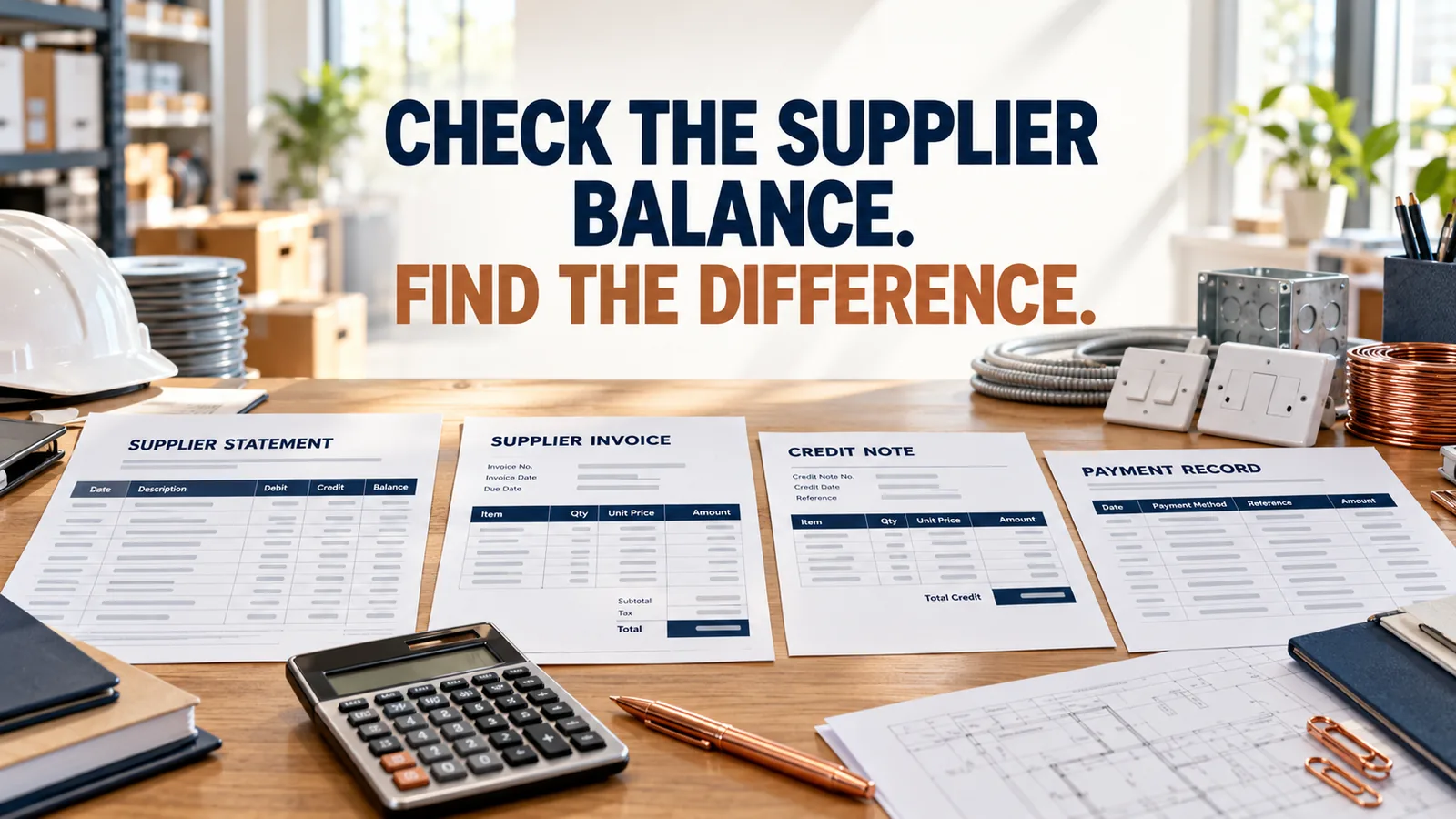
Compare the supplier’s statement and your payable records at the same cutoff. Match individual invoice, credit and payment references before relying on the balance. A promised return credit, a sent payment and an applied vendor credit are different events; preserve each difference until its evidence is resolved.
A supplier balance is an account question
Consider an illustrative electrical subcontractor receiving a monthly statement from a materials supplier. It lists two projects, a recent payment and a credit for returned stock. The supplier’s total is higher than the office ledger. Rechecking the addition alone will not explain whether a payment is missing or whether the return credit was never posted.
This review focuses on what your business owes a supplier. It is different from the customer-facing invoice credit-memo guide and from matching one supplier bill to a purchase order. Keep the vendor account and each job’s cost support connected without merging their purposes.
Intuit’s vendor guidance distinguishes bills, payments, purchase orders and vendor credits within the supplier record. Use those transaction references to explain the statement balance. This article does not prescribe accounting entries or claim an automatic Texas Notice Tracker payable module.
Retainage payable needs its own supplier or lower-tier subcontract record
Retainage payable describes an amount your business owes downstream that remains held under the applicable agreement. A supplier-statement difference alone does not authorize withholding. First establish whether the vendor or lower-tier subcontract actually permits retention and which amount it covers.
Original illustration: a lower-tier subcontract billing is $10,000, with an assumed agreed 5% retainage, no tax, credits or other deductions, and $9,500 actually paid and allocated. The remaining $500 is held, not paid. If release of $300 is later approved and only $200 is paid, $200 stays held and $100 is released but unpaid. Total still owed is $300.
Compare the same cutoff on your payable schedule and the other party’s statement. Document category transfers without treating them as cash. Keep the retainage receivable guide separate: what your customer owes you and what you owe downstream are different balances.
| Example state | Held | Released but unpaid | Total still owed |
|---|---|---|---|
| After $9,500 allocated payment | $500 | $0 | $500 |
| After $300 approved release | $200 | $300 | $500 |
| After $200 release payment | $200 | $100 | $300 |
Build a common cutoff and a reference map
Request the statement period and the supplier account reference. Export or save the matching vendor ledger from your approved accounting system using the same date. Confirm whether branch locations, subaccounts or currency differences are included.
For every listed invoice, establish its source bill, project and receiving support. A statement line by itself may not include enough detail to confirm the goods, rate or contractual basis. Obtain the original document when the reference is unfamiliar rather than creating a bill solely from a total.
For payments, retain the actual payment evidence and its bill allocation. A payment initiated shortly before cutoff may be recorded by your office before the supplier applies it. That is a reconciliation item, not proof that the supplier’s debt record is intentionally wrong.
| Record | Question to resolve |
|---|---|
| Opening balance | Does it agree with the previous reconciled cutoff? |
| Supplier invoice | Is the original bill recorded once and on the correct job? |
| Vendor credit | Was it issued, recorded and applied as appropriate? |
| Payment | What was paid and what did the supplier allocate? |
| Unmatched line | Which original document or confirmation is missing? |
Worked example: a $500 payment-allocation difference
Original illustrative account: opening payable balance $9,000; new bills $4,500; posted supplier credit $750; payments recorded and supported in your books $8,000. The reconciled ledger calculation is $9,000 plus $4,500 less $750 less $8,000, leaving $4,750.
The supplier statement shows the same opening balance, bills and credit but only $7,500 of applied payments. Its total is $5,250. The $500 difference is therefore a payment reconciliation item in this example. Confirm the payment reference, receipt and supplier allocation before deciding how to resolve it.
The example assumes valid bills and credit, no interest or fees, no foreign currency and no other adjustments. It does not instruct you to reduce the next payment unilaterally or determine whether an amount is legally due. Preserve the discrepancy and follow the actual agreement and authorized accounting review.
| Account movement | Your ledger | Supplier statement |
|---|---|---|
| Opening | $9,000 | $9,000 |
| New bills | +$4,500 | +$4,500 |
| Recorded credit | −$750 | −$750 |
| Payments shown | −$8,000 | −$7,500 |
| Ending balance | $4,750 | $5,250 |
| Difference to investigate | $500 | Payment reference / allocation |
A returned item is not yet a posted credit
Keep the return authorization, pickup or receiving record and supplier credit document as separate evidence. A field note saying “returned ten units” does not establish the amount or date of a vendor credit. Ask for the credit reference and the invoice or account to which it relates.
Do not net a promised credit against a bill and then subtract the issued credit again. Have the authorized accounting reviewer confirm what has already been recorded. Keep damaged stock, quantity shortages and pricing corrections distinct because their supporting documents differ.
If the credit relates to costs previously passed through to a customer, route that question separately. A supplier credit does not automatically decide whether a customer invoice requires an adjustment. Use the actual agreement and accounting policy for that downstream review.
Assign one resolution path to each difference
Classify the exception as a missing invoice, missing credit, unmatched payment, duplicate posting or disputed charge. Assign an owner and the specific evidence needed. Avoid a generic “supplier account wrong” status that makes the next reviewer repeat the whole exercise.
For a missing payment, an original factual request might say: “Our October 13 ledger includes payment reference P-204 for $500, which is not allocated on your statement. Please confirm receipt and the invoice allocation.” Do not include full bank-account details in a broadly shared review sheet.
For a questionable charge, identify the source invoice and line. Compare its scope and receiving records using the delivery-ticket guide. Keep the financial exception open while the commercial reviewer obtains the written basis.
Save the reconciliation and its supporting documents
Download the blank supplier statement review sheet (CSV). Save a dated copy with the supporting records after your review.
The supplier-statement reconciliation CSV records each supplier reference, your matching record, amount, cutoff difference and owner. Keep a dated copy of the statement and ledger beside the completed sheet so a later posting does not rewrite the earlier review.
Update the cash collections forecast only for its receivable purpose; supplier payables belong in the appropriate outgoing-cash plan. Do not offset what you owe one vendor against what a different customer owes your business merely to simplify a dashboard.
- Match account scope and cutoff first.
- Trace each bill to an original document.
- Check issued credits and their accounting treatment.
- Compare payment references and allocations.
- Save unresolved differences with named owners.
Supplier statement questions
Should I enter the statement total as a new bill? Check the original bills. Entering the total again can duplicate charges already recorded.
Can I treat a return slip as a vendor credit? Keep the return evidence, then obtain the issued credit and appropriate accounting review. The records serve different purposes.
What if the supplier has not applied a payment? Supply the reference and ask for confirmation. Preserve the difference without guessing its allocation.
Does a reconciled account total prove every invoice is valid? No. The account may add correctly while a particular scope, rate or receiving item still requires review.
Related reading
Turn project facts into a review queue.
Keep unpaid work months, parties, invoices, documents and estimated review dates in one private workspace.
Create your free accountOfficial sources
- Intuit: viewing and distinguishing vendor transactions
- Intuit: expense, payable and vendor-credit guidance
Source note: Reviewed October 14, 2026. Verify the current statute and obtain qualified advice for a specific project or claim.