Can a Texas subcontractor stop work for nonpayment? Review before suspending
Review Texas Section 28.009 before suspending construction work: payment facts, written notice, exclusions, dispute checks and a practical evidence file.
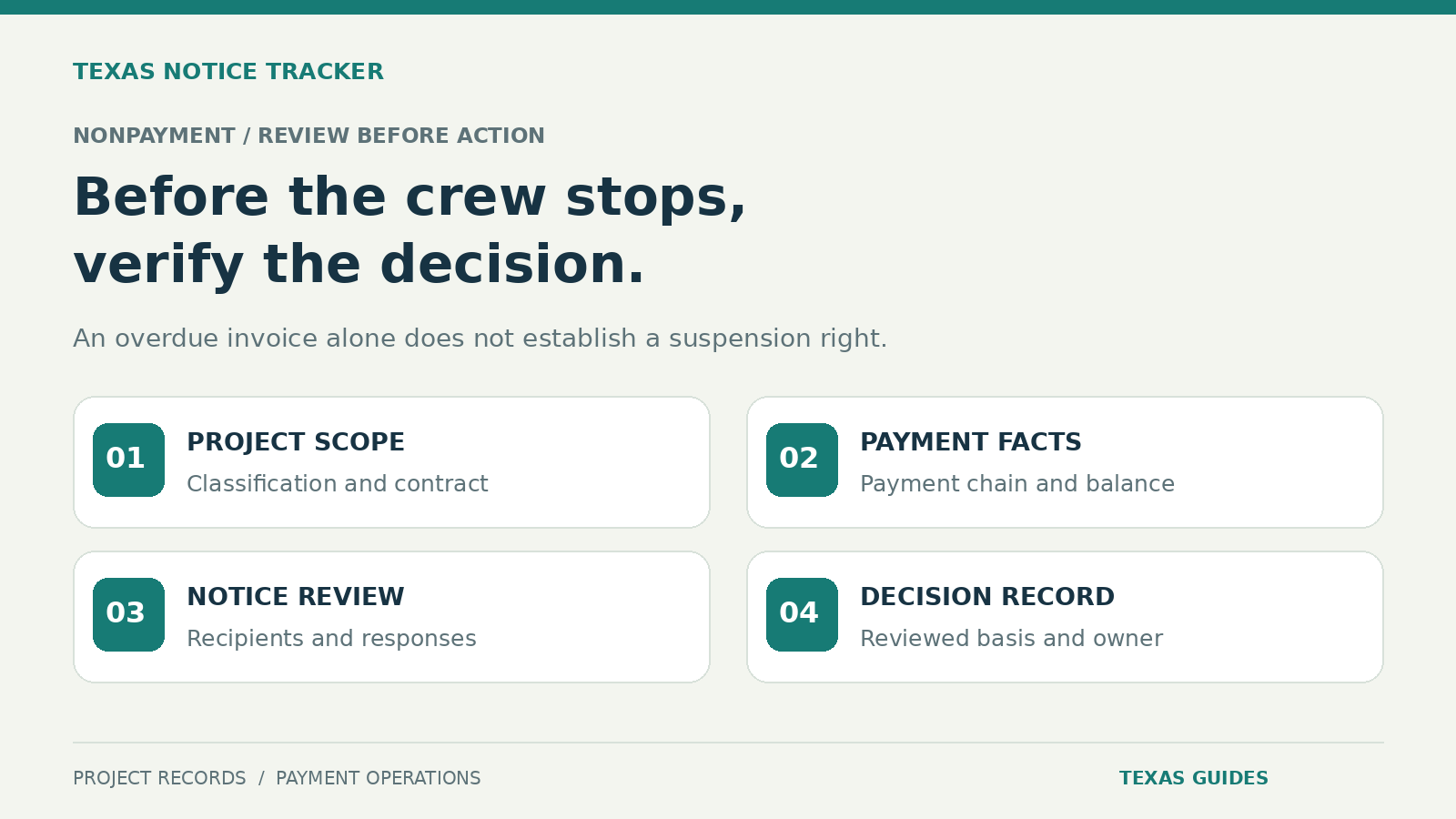
Direct answer
Section 28.009 provides a conditional suspension route when the owner has not timely paid the contractor an undisputed amount. It is not triggered merely because your invoice is overdue. Review eligibility, payment history, written notice, lender conditions and any dispute response with qualified Texas construction counsel before directing a crew to stop.
An overdue subcontractor invoice does not answer the stop-work question
Your accounts-receivable report says a progress billing is late. The superintendent asks whether the crew will return tomorrow. Those are different decisions. Collection follow-up needs an accurate balance; a suspension decision also needs the governing contract, payment-chain facts and a reviewed basis for stopping performance.
The statutory trigger in Section 28.009(a) is owner nonpayment to the contractor of an undisputed amount within the chapter’s time limits. Do not equate that fact with a contractor having received the owner’s payment but failing to pay you. Ask counsel to identify the applicable route rather than labeling every late invoice a statutory right to walk off.
This guide is an evidence-preparation workflow for review. It is not a stop-work notice template, a calculator or authorization to suspend. A project manager should not infer permission from an aging bucket or from a reminder generated by software.
Check project type and statutory scope first
Section 28.009 excludes detached single-family residences, duplexes, triplexes, quadruplexes and improvements for governmental entities. Chapter 28 also contains mineral-development and oilfield-service exclusions. Its suspension process requires written notice to the owner and a conditionally required lender; the statute describes the tenth day after notice as the suspension point.
A qualifying lender’s notice obligations depend on the detailed loan, security, funding, posting and delivery conditions in subsection (b). Before suspension, a written payment or good-faith-dispute response can affect the protection described in subsection (c). Subsection (d) requires specific dispute reasons and addresses an opportunity to cure or compensate for certain deficient work.
Those are the statutory boundaries, not a checklist that this article can certify for your job. Give counsel the project classification, original documents and full correspondence so the lender conditions, notice timing and any response can be evaluated against the current text.
Build the payment-chain record before discussing dates
Start with the exact contract parties. Identify the owner, the original contractor, your direct contracting party and any relevant higher-tier subcontractor. A jobsite trade name can conceal the legal entity that signed the agreement. Use the executed documents rather than a nickname in an email subject.
Collect the relevant payment requests, proof of receipt, payment information and stated reasons for withholding. If the date of owner payment is unknown, mark it unknown. Do not fill the field using the date a project manager promised that funds would arrive.
Reconcile the invoice balance against credits, receipts, disputed change items and retainage. A $30,000 outstanding total may contain several categories with different supporting facts. The Texas prompt-payment guide gives context for reviewing the payment chain separately from ordinary invoice aging.
| Fact to collect | Best available record | If missing |
|---|---|---|
| Contract parties | Executed agreements | Request the correct entity information |
| Project classification | Contract and ownership records | Flag classification for counsel |
| Payment request and receipt | Submitted packet and delivery evidence | Preserve portal or email history |
| Owner-to-contractor payment | Confirmed transaction or written response | Record as unknown; do not assume |
| Unpaid amount and disputes | Reconciled ledger and correspondence | Separate unsupported items |
| Lender information | Financing records and required project notices | Have notice conditions reviewed |
Hypothetical example: two late invoices, different review files
Two commercial electrical projects each show a $20,000 unpaid subcontractor balance. On Project A, the contractor confirms receipt of the relevant owner payment but has not remitted your portion. On Project B, the available correspondence says the owner has not paid the contractor. The receivables amounts match, but the payment-chain facts do not.
Neither record authorizes suspension by itself. For Project A, ask which payment and contractual remedies apply to the downstream nonpayment. For Project B, have counsel review whether the owner nonpayment involves an undisputed amount due under the applicable law, whether the suspension provision applies, and what notices and responses matter.
Prepare separate chronology sheets. Include the source of each statement, not just the conclusion. “GC email dated October 7 says owner funds received” is a usable reference; “owner must have paid by now” is an assumption. Keep a disputed or unverified fact visible until it is resolved.
Treat notice preparation as a reviewed task
Do not reuse a collection email, demand letter or lien notice simply by changing its heading. A communication prepared for one purpose may have the wrong recipient, content, timing or delivery basis for another. Ask the reviewer to identify the required notice and any parallel contractual procedure.
Preserve the approved final version and its attachments, recipient details, dispatch evidence and subsequent responses. Do not keep only a draft in the project folder while the superintendent acts on a different message sent from a phone. Assign responsibility for monitoring replies through the proposed decision point.
Use the project-information request guide when basic party or project records are missing. Obtaining those facts early makes a later nonpayment review more efficient; it does not establish that the suspension conditions are met.
Prepare a site plan without treating preparation as authorization
An operational plan can be prepared while counsel reviews the legal decision. List the crew, active tasks, temporary power, weather exposure, open penetrations, equipment, stored materials and any safety-critical condition. Identify who can give instructions and who communicates with the site team.
Estimate potential demobilization and remobilization costs from actual quantities and arrangements. Separate internal planning estimates from amounts legally recoverable. Preserve supplier cancellation terms, equipment-rental documents and transportation quotations so a later review has support.
Keep a dated record of site conditions and communications. A coordinated plan helps the business respond clearly to the reviewed decision. It does not cure an invalid suspension or excuse ignoring a payment or dispute response.
Keep notice and lien review on a separate track
An active payment dispute can absorb everyone’s attention. Continue maintaining the work-month ledger, delivery records and contract history while the team reviews a suspension. Do not mark a notice task complete merely because a proposed stop-work letter is being discussed.
Use the monthly notice guide and mechanics lien timeline for the separate questions. Have the professional reviewer confirm the applicable steps for the actual project. Record what was reviewed, what remains unresolved and who owns the next task.
The most useful office file distinguishes facts from decisions. A recorded overdue balance is a fact. A recommendation to send a reviewed notice is a decision. A decision to suspend needs its own documented basis and authority.
Before-suspension review checklist
Bring the following packet to the person reviewing the decision. Keep missing items visible and avoid issuing a crew instruction while the underlying recommendation is still conditional.
- Executed contract and applicable notice clauses.
- Verified project type and contracting chain.
- Payment requests, receipt evidence and reconciled balance.
- Confirmed payment-chain facts, with unknowns labeled.
- All payment and dispute communications.
- Owner and lender information for notice review.
- Reviewed final notice and dispatch evidence, if applicable.
- Site, crew and equipment planning records.
- Separate notice and lien review queue.
- Written decision owner and documented next action.
Stop-work questions
Can I stop tomorrow because my invoice is 60 days old? Invoice age alone does not establish that Section 28.009 applies. Have the payment chain, contract and notice process reviewed first.
Does this procedure apply to every Texas project? No. Project and statutory exclusions matter. A public job or an excluded residential contract cannot simply use this article’s private commercial review path.
What if a dispute response arrives? Preserve it immediately and send it to the reviewer before the proposed suspension. Do not assume a previously discussed plan remains valid.
Can Texas Notice Tracker authorize a suspension? No. It organizes records and review tasks. Qualified counsel and the responsible business decision-maker must assess the project-specific action.
Related reading
Turn project facts into a review queue.
Keep unpaid work months, parties, invoices, documents and estimated review dates in one private workspace.
Create your free accountOfficial sources
- Texas Property Code Chapter 28: Sections 28.009 and 28.010
- Texas Property Code Chapter 53: separate lien-notice framework
Source note: Reviewed October 9, 2026. Verify the current statute and obtain qualified advice for a specific project or claim.