Texas construction joint-check agreements: payment allocation before endorsement
Review a Texas construction joint-check agreement with a supplier allocation example, endorsement checks, payment records and separate waiver review.
Direct answer
A joint check names multiple payees, often a subcontractor and its material supplier. Before anyone endorses it, reconcile the covered invoices, agreed allocation, deposit process and any accompanying release. A check amount is not automatically the cash available for your payroll, and a joint-check agreement is not a substitute for separate lien-notice review.
What a joint check does—and what the agreement must explain
A supplier places the next shipment on credit hold. The general contractor proposes a check made payable to both your company and the supplier so that material payment can be coordinated. That may solve an immediate delivery problem, but the office still needs to know which debt is being paid and how the transaction changes both account balances.
The check and the agreement perform different jobs. The check identifies payees and an amount. The agreement should explain the parties’ instructions and expectations: project, covered purchases, allocation, processing, credit confirmation and responsibility for any remaining balance. Have counsel review the proposed document rather than assuming a familiar title makes its terms standard.
This guide focuses on a practical recordkeeping workflow. It does not supply a signable agreement or decide the legal effect of an endorsement, release or supplier claim. Public programs and financing arrangements can impose additional conditions.
Review these fields before the check is issued
Collect the supplier statement and compare it with your purchase orders, delivery tickets, credits and previously paid invoices. A statement can include another project, freight adjustments, returned materials or a balance from an earlier job. Resolve those differences before agreeing that the full statement belongs in this payment.
Use exact legal business names and identify who has authority to sign for each party. Confirm the proposed payee wording with the bank. Texas Business & Commerce Code Section 3.110(d) distinguishes alternatively named payees from jointly named payees; ambiguity is treated as alternative payment. Wording therefore matters. Do not change the face of a check yourself to repair an unclear arrangement.
| Review item | Question to answer | Record to keep |
|---|---|---|
| Covered project | Which job and supplier account? | Agreement and project identifier |
| Covered debt | Which invoice numbers and credits? | Reconciled invoice schedule |
| Allocation | How much goes to each party? | Written allocation instructions |
| Processing | Who deposits and confirms payment? | Bank instructions and receipt |
| Remaining balance | What is still owed afterward? | Updated supplier and project ledgers |
| Release language | What rights or amounts are covered? | Reviewed check, agreement and waiver |
Worked example: a $24,000 check is not $24,000 of free cash
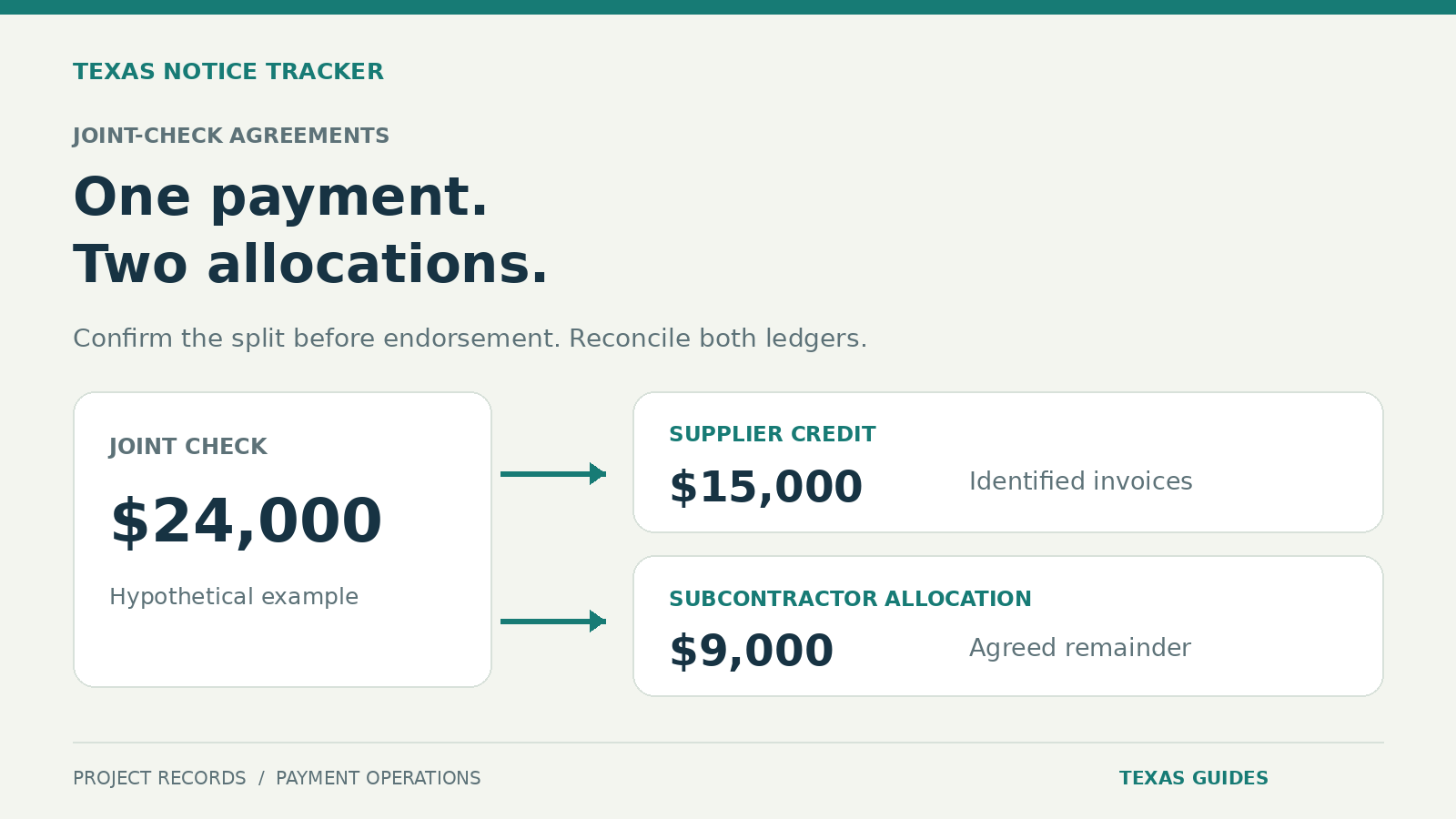
Hypothetical example: a general contractor owes an electrical subcontractor $24,000 on one approved progress billing. The agreed joint-check allocation sends $15,000 to the supplier for three identified material invoices and $9,000 to the subcontractor. These figures are an original bookkeeping illustration, not a legal allocation rule.
The receivable reduction is one $24,000 payment under the example’s agreed processing. The $15,000 supplier allocation settles the identified payable, while $9,000 remains available to the subcontractor. Do not record $24,000 received and then add another $15,000 customer payment. That would overstate collections. Ask your accountant to select entries appropriate to the actual movement of funds and your accounting system.
Suppose the supplier account had $18,000 outstanding before the transaction and the specified $15,000 is confirmed credited. The remaining supplier balance is $3,000. Your project receivable and your supplier payable are separate ledgers; settling one does not establish that every obligation on the job has been paid.
| Example item | Amount | What it means |
|---|---|---|
| Joint-check total | $24,000 | One customer payment in this example |
| Supplier allocation | $15,000 | Credit to identified supplier invoices |
| Subcontractor allocation | $9,000 | Remainder under the agreed instructions |
| Supplier balance before credit | $18,000 | Separate payable ledger |
| Supplier balance after credit | $3,000 | $18,000 minus $15,000 |
Follow the transaction through credit confirmation
Keep an issued check in a pending-payment status until its processing is established. Record check number, issue date, payees, intended allocation and the person handling deposit. A photograph of an unsigned check is evidence of an intended transaction, not a complete account reconciliation.
After processing, obtain confirmation from the supplier showing the credited invoices and updated account balance. Compare that confirmation with the canceled-check or bank record and your agreed schedule. If a payment was applied to an older account balance instead of this project’s invoices, flag the difference immediately and request a written explanation.
Maintain the original files even when a dashboard displays a simple paid status. A reviewer should be able to trace the transaction without reconstructing the story from telephone calls. The partial-payment record guide explains how to keep unapplied cash and unpaid balances visible.
Review waivers and settlement wording separately
Read the front and back of the check, attached letter and agreement before endorsement. Section 3.311 addresses payment instruments tendered in full satisfaction of disputed or unliquidated claims, subject to its conditions and exceptions. Escalate unexpected full-settlement language before processing; crossing out a phrase is not a reliable substitute for legal review.
Match any proposed waiver to the payee, actual payment, project, covered period and payment type. Use the Texas conditional and unconditional waiver guide for the separate statutory-form questions. Do not mark all invoices released merely because a supplier received one allocation.
Keep unresolved amounts on a review list. Negotiating a joint-check arrangement does not by itself establish that notice or filing obligations have been satisfied. Continue reviewing the unpaid items through the Texas monthly notice workflow.
TxDOT DBE arrangements have their own requirements
TxDOT’s DBE joint-check guidance requires prior approval and a supporting package that includes Form 2178 and an agreement. It also describes supplier-credit circumstances, the subcontractor’s control over purchasing, and records of paid invoices and canceled checks. These are program-specific requirements, not a universal rule for every private Texas project.
If the project involves a TxDOT DBE arrangement, identify the applicable program requirements before borrowing a private-job procedure. Ask the responsible project administrator which current documents and approvals apply. Keep that answer in the project file alongside the signed documents.
Joint-check review checklist
Assign one office owner to track the transaction from agreement review through reconciliation. This is especially useful when a project manager negotiates the arrangement but the bookkeeper later receives only the check image.
- Match legal names, project and supplier account.
- Reconcile invoices, returns, credits and earlier payments.
- Confirm written allocation and bank processing instructions.
- Review settlement wording and each accompanying waiver.
- Keep issuance, deposit and credited-payment facts separate.
- Update both ledgers once, with supporting references.
- Keep remaining balances and notice-review tasks open.
Joint-check questions subcontractors ask
Does a joint check guarantee the supplier is paid? Naming the supplier does not establish the completed transaction. Confirm processing and the supplier’s invoice credits.
Can the supplier keep the whole check? The answer depends on the documents, debt, payee wording and applicable law. Resolve allocation and obtain advice before endorsement when the parties disagree.
Does signing a joint check automatically release every lien right? Do not assume a universal result. The check, accompanying communications, agreement and waiver language all need review.
What if the supplier statement includes two jobs? Separate the project balances and obtain specific allocation instructions. Preserve the original statement and the reviewed schedule.
Related reading
Turn project facts into a review queue.
Keep unpaid work months, parties, invoices, documents and estimated review dates in one private workspace.
Create your free accountOfficial sources
- Texas Business & Commerce Code Chapter 3: Sections 3.110 and 3.311
- TxDOT DBE Compliance Guide: Chapter 15, Joint Checks
- Texas Property Code Chapter 53: notices and waiver framework
Source note: Reviewed October 9, 2026. Verify the current statute and obtain qualified advice for a specific project or claim.