Construction equipment rental invoices: verify off-rent and pickup records
Review construction rental charges against equipment identity, contract terms, off-rent confirmation and pickup evidence with an original cost example.
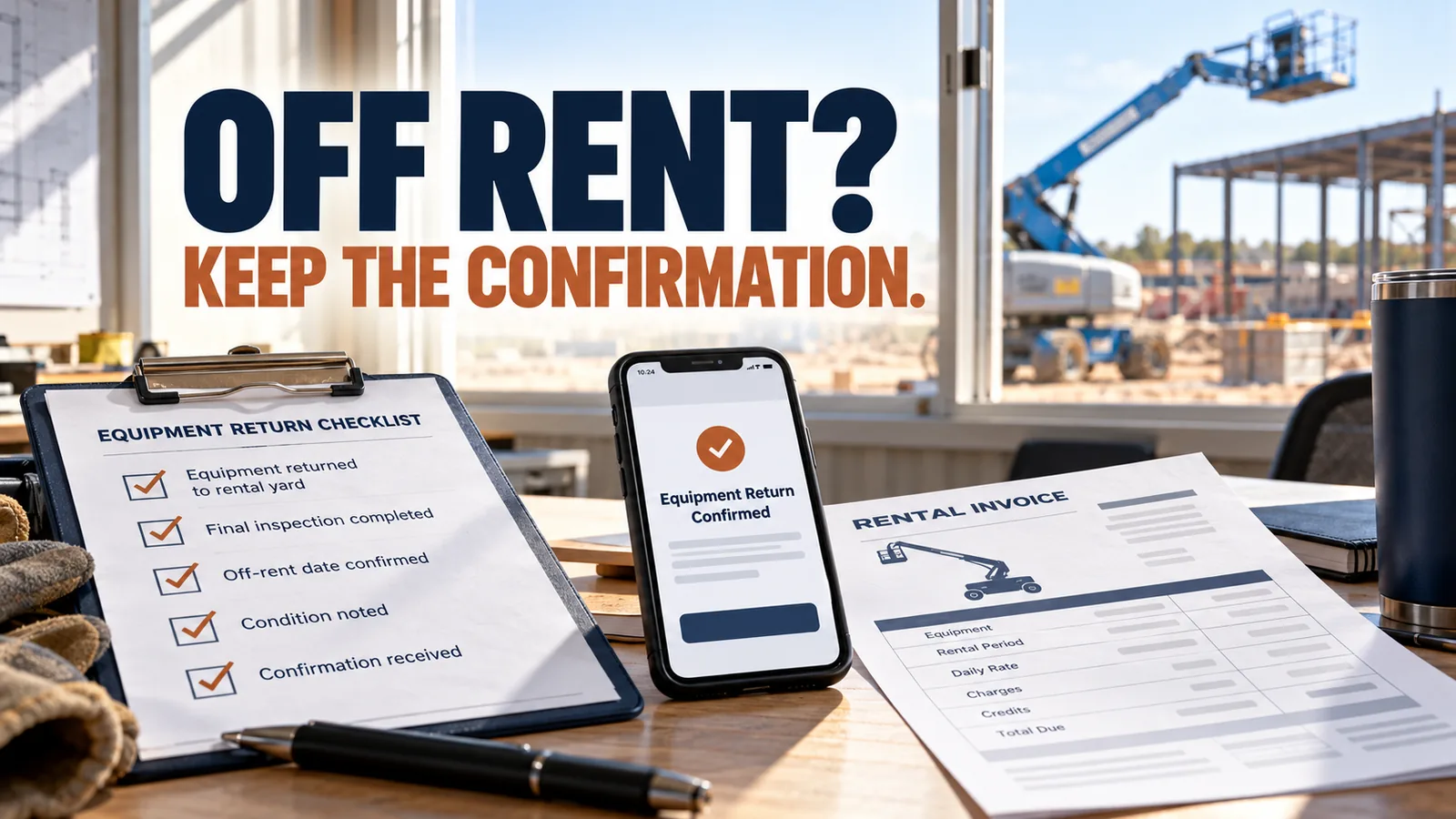
Direct answer
Compare the rental agreement, equipment ID, billing basis, off-rent confirmation and actual return or pickup record. Last use, off-rent request and physical collection can be different events. Establish the supplier’s actual contractual charging rule before challenging days or calculating a credit.
The last workday may not be the last rental-charge day
Consider an illustrative Texas trade contractor finishing work with a rented lift on Friday. The crew leaves it available for collection and the office calls on Monday. A later invoice includes days after Friday. The review needs the agreement and event records; a crew’s last-use date alone does not establish the correct charge.
United Rentals’ published US terms are a supplier-specific example. Section 15.1 ties the end of rental charges to return during store hours, or pickup after the customer calls the equipment off rent and obtains a confirmation number. It also identifies separate delivery and pickup charges. These are not statewide rules: check the signed agreement, equipment-specific provisions and actual confirmation.
This guide reviews the payable charge for rented equipment. It does not decide whether that cost can be rebilled to a customer or supports a lien. Keep any customer-facing T&M billing review separate.
Confirm the equipment before calculating the period
Match the invoice to the rental contract, equipment number and jobsite. Several similar lifts can move between projects during the same month. An invoice description such as “scissor lift” is not enough to establish which unit the site returned.
Retain delivery, exchange and transfer records. If the supplier substituted a unit, preserve the original and replacement identifiers and dates. Ask which charges relate to the exchange instead of combining both units into one continuous period without explanation.
Check the rate basis, minimum term, billing cycle, usage limits and separate fees. Do not calculate a daily rate by dividing a weekly price unless the agreement uses that conversion. A four-week period, calendar month and daily rate are not interchangeable labels.
| Record | Why it matters |
|---|---|
| Rental agreement / unit ID | Connect the charge to the equipment |
| Delivery or exchange event | Support the starting chronology |
| Last-use record | Identify when field use stopped |
| Off-rent request and confirmation | Support the supplier communication |
| Pickup / return evidence | Establish the physical handover |
| Rate and fee schedule | Explain the billing calculation |
Keep the request and the confirmation
Record who contacted the supplier, when, through which approved channel and what equipment was called off rent. Save the confirmation number or written response when the supplier provides one. A note saying “called rental company” is less useful than a reference tied to the unit and contract.
Also document pickup readiness and access. Store the location and an appropriate contact in a controlled record. If a gate, missing accessory or other issue delays collection, preserve the supplier’s explanation and relevant site evidence instead of assuming all delay has the same billing effect.
The supplier’s own terms may address responsibilities that continue after an off-rent request. Do not promise a customer that charges or custody obligations always stop at the phone call. Get the actual arrangement reviewed when an amount or responsibility is disputed.
Worked example: the arithmetic follows an assumed agreed period
Original simplified illustration: a supplier confirms that the reviewed billing period contains 5 chargeable days at an agreed $180 daily rate. The agreement separately supports $120 delivery and $120 pickup charges. No tax, fuel, damage, usage surcharge, cleaning or other fee is included in this arithmetic example.
The rental component is $900. Adding the two $120 transport charges gives $1,140 before tax and any other properly supported items. If the invoice instead lists 7 days at $180 plus those same charges, its corresponding subtotal is $1,500. The $360 difference requires a period review.
Five chargeable days are an assumed confirmation, not a conclusion based on the last-use date. Ask the supplier to identify the contractual start and end events for the extra two days. A different agreement or confirmed chronology can justify a different number; the example does not establish a credit entitlement.
| Line | Confirmed illustrative basis | Amount |
|---|---|---|
| Rental | 5 days × $180 | $900 |
| Delivery | Agreed separate charge | $120 |
| Pickup | Agreed separate charge | $120 |
| Subtotal before tax / other items | Illustrative reviewed basis | $1,140 |
| Two additional days questioned | 2 × $180 | $360 |
Review additional lines independently
For fuel, cleaning, damage or usage charges, obtain the line description, rate basis and relevant inspection or meter support. Do not label every extra charge unauthorized; compare it with the actual agreement and facts.
Likewise, do not accept a fee solely because it appears on the invoice. The office should be able to explain the basis and refer it to the authorized reviewer. Record the claimed amount and the portion questioned without altering the original document.
If the expense will be allocated across jobs, preserve the allocation basis separately from supplier liability. An internally sensible job-cost split does not change what the rental agreement says. Use the PO matching review for the order reference and approved scope.
Use an event-based rental review sheet
Download the blank equipment rental review sheet (CSV). Save a dated copy with the supporting records after your review.
The equipment-rental review CSV records the unit, contract, event dates, confirmation reference, rate basis and charge difference. Link the supporting documents and identify the person responsible for the supplier inquiry.
Keep the original invoice and any resulting credit or revised invoice together. Apply an authorized adjustment through the approved accounting process. If equipment is still on site, assign the return task as well as the billing task; resolving one does not automatically complete the other.
- Match the rental contract and unique unit ID.
- Preserve the last-use, request and pickup events separately.
- Check the actual rate basis and minimum period.
- Request evidence for any disputed additional charge.
- Record the authorized resolution and remaining return task.
Rental invoice questions
Does calling equipment off rent always stop charges immediately? Do not assume a universal rule. Read the actual agreement and confirmation.
Can I divide a monthly invoice into daily amounts? Use the contractual billing basis and minimum periods. A convenient spreadsheet division can be wrong for that agreement.
What if pickup occurs after the crew leaves? Preserve the request, access arrangements and actual handover, then obtain a review of the charging terms.
Is an equipment-rental invoice the same as customer T&M billing? No. Review the supplier charge and the customer agreement separately before deciding any pass-through treatment.
Related reading
Turn project facts into a review queue.
Keep unpaid work months, parties, invoices, documents and estimated review dates in one private workspace.
Create your free accountOfficial sources
Source note: Reviewed October 14, 2026. Verify the current statute and obtain qualified advice for a specific project or claim.